Home / Study plans
Study plans · free · no signup
Build an HSK study plan that fits where you actually are
A study plan is not a longer word list, it is an order of operations. This page hands you the same four-step path for any level: place yourself, open the right word table in frequency order, hold a daily target you can sustain with reviews first, then drill. Below it, pick the plan for your band and get concrete, arithmetic-derived timelines. Not sure where you sit? Take the free placement test.
Quick answer
What is the best way to make an HSK study plan?
Start by placing yourself with a short recognition test so you skip words you already know. Open the word table for your level, learn it in frequency order, and set a daily new-word target you can repeat, clearing reviews before adding new cards. Spaced-repetition software runs the schedule so your only daily decision is to show up.
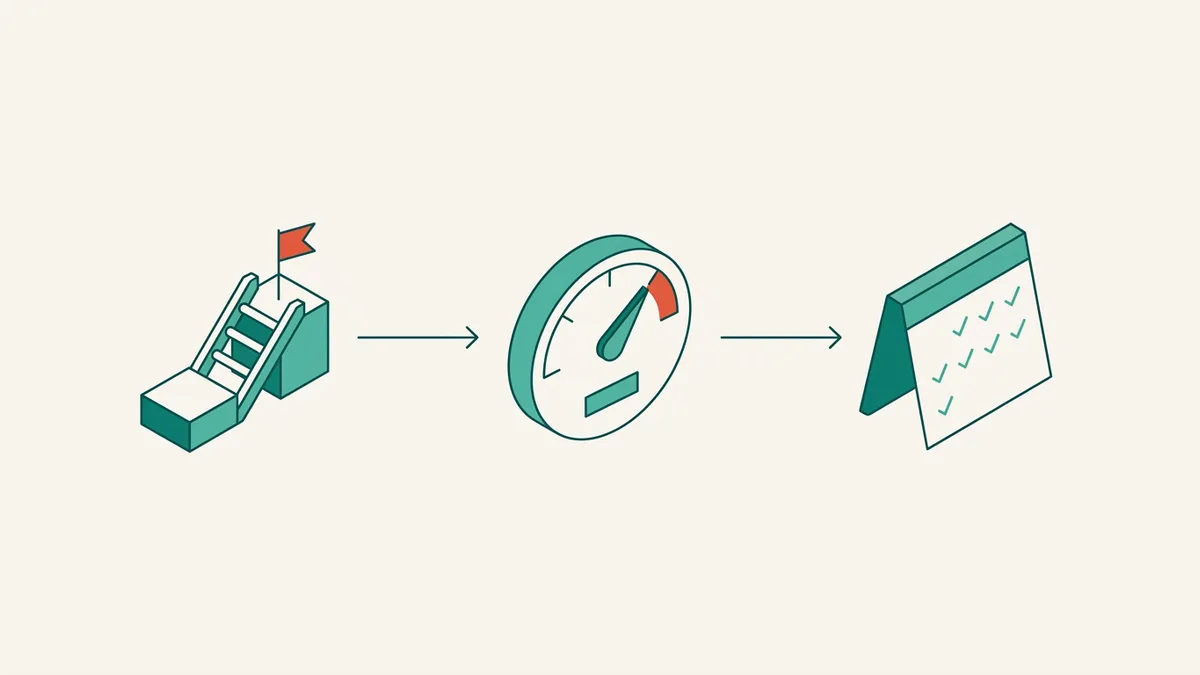
The path, in four steps
works at any levelFrom "where do I even start" to a daily habit
Every plan on this site follows this order. The only thing that changes by band is the size of the list and the calendar.
- 1 Find your levelPlacement test, about five minutes, free place
- 2 Open the right word tableLearn it in frequency order, most common first read
- 3 Set a sustainable daily targetReviews first, then new words, every day daily
- 4 Drill with spaced repetitionThe app schedules each word's next review drill
Pick your plan
three bands · timelines| Plan | New words | At 5 to 10 / day | What "done" means | Open plan |
|---|---|---|---|---|
| Beginner Levels 1 to 3 | 2,209 | ~7 to 15 mo | Recognize every beginner word and hold a basic spoken exchange. | Open plan → |
| Intermediate Levels 4 to 6 | 3,154 | ~10 to 21 mo | Read simplified articles with light dictionary help and argue a point. | Open plan → |
| Advanced Levels 7 to 9 | 5,606 | ~18 to 37 mo | Read literature and professional texts near educated-native range. | Open plan → |
Timelines count new-word acquisition only, at a steady 5 to 10 new words a day (10/day is the faster end, 5/day the slower). They exclude grammar, listening, handwriting, and the review load that grows as your pile of known words does, so read each as a floor, not a finish line. The word counts are computed from the shipped HSK 3.0 word list, so they cannot drift from the data.
Why the order is frequency, not level padding
A handful of very common words do most of the talking. Because those words sit at the bottom of the ladder, the first HSK level alone already covers about 50.4% of the words spoken in everyday Chinese, and the climb flattens fast after that. Learning in frequency order means every word you add is the most useful one still missing, so your reading and listening improve from day one instead of waiting for a milestone. Every word table on this site sorts by frequency inside each level, so "start at the top and work down" is a literal instruction.
This is method, and it is the same method in how to learn HSK vocabulary. What the plans below add is the personalized part: which list, how many a day, and what finishing your band actually buys you.
Recognition first, production later
| Recognition | Reading a word when you see it. This is faster to build and unlocks reading and listening immediately, so every plan drills recognition first, across the whole list. |
| Production | Recalling and using a word yourself in speech or writing. It is slower and should trail behind, concentrated on the everyday words you will actually say, not every rare term on the list. |
| Why split them | Chasing production on every word doubles your workload for vocabulary you will only ever read. A recognition-heavy plan keeps the daily load sane while still growing what you can understand fastest. |
Want the schedule run for you?
Step 3, reviews before new cards, is the part manual study quietly drops. It is also why I built Wordbrush: it holds your whole list, schedules each word with a modern algorithm, and guards the review queue. It is my app, so treat this as the recommendation of a very invested maker.
Do not know which plan is yours?
The placement check estimates your HSK level from a short recognition test, then links you straight into the right word table, in frequency order. No signup.
Last reviewed 2026-09-11 by Mandarin Steps editorial team. Word counts computed from the shipped HSK 3.0 list; timelines are arithmetic from the stated daily paces. Method reflects established second-language vocabulary research, described as method and not as official HSK guidance.